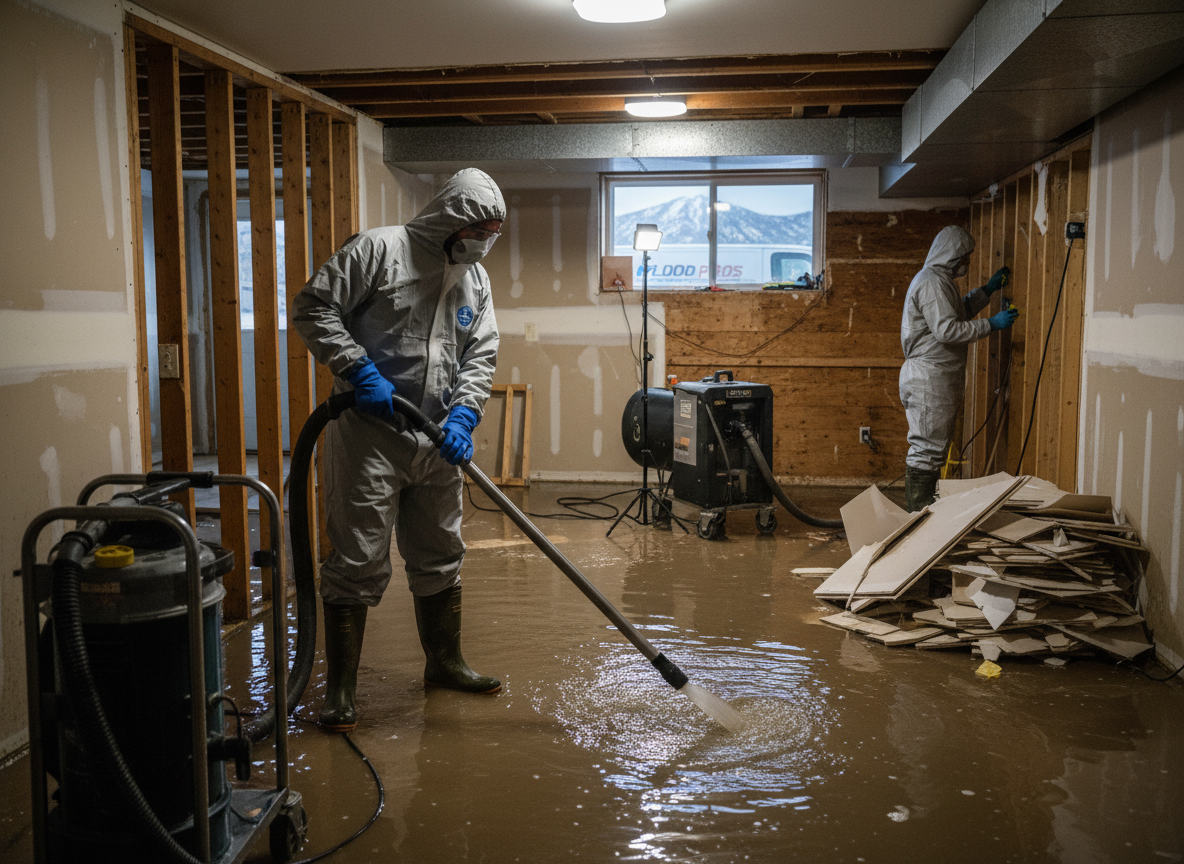
Holladay sits in the foothills where winter snow loads on roofs and frozen supply lines in older Mount Olympus and Holladay Village homes often fail once temperatures swing. Water travels along slab edges and into finished basements before homeowners notice. Restoration crews must pull saturated carpet pads and drywall quickly because the semi-arid air still holds enough moisture in wall cavities to feed mold within days. Cottonwood Heights and Millcreek properties share the same risk when rapid snow melt meets older clay sewer laterals that back up during heavy spring runoff.
Flood jobs here differ from coastal flooding because the water is usually clean at first but picks up silt from local soil once it enters crawl spaces. Technicians use moisture meters on concrete slabs common in 1960s–1980s builds around Olympus Hills Park and Holladay City Park to map hidden saturation. Containment barriers go up immediately to keep dust and spores from migrating into living areas during demolition. Extraction equipment runs continuously because daytime heat in summer can push remaining moisture deeper into subfloors before night temperatures drop again.
Salt Lake County building practices require proper drying documentation before any reconstruction permit is issued. Crews document every step with photos and meter readings so homeowners can show insurers the work meets local standards. In neighborhoods with steep driveways, portable generators and long hose runs become necessary when power is lost during storms. Addressing the source, whether a failed main or hillside seepage, always comes before cosmetic repairs to prevent repeat calls the following winter.
Technician insight
In Holladay the thing that catches most people out with Flood restoration services is how fast snow-melt water travels under the slab in 1970s homes around Mount Olympus. Homeowners often stop at the wet carpet and miss the fact that the same water has wicked six feet into the drywall behind the baseboards. We always pull base plates on the first visit because once those studs stay damp through another cold night the job doubles.
Burst Supply Line Under Slab
A Mount Olympus home lost water from a frozen line that thawed midday. We found water had traveled under the slab into the finished basement and up two feet into perimeter walls. Extraction and targeted wall removal dried the structure in four days; the owners moved back in without mold issues the following week.
How it works
- 1
Emergency Assessment
Arrive on site within hours, locate the water source, and document affected rooms in Holladay Village or Mount Olympus properties.
- 2
Water Extraction
Remove standing water with truck-mounted pumps and portable units suited to basements common in Salt Lake County homes.
- 3
Drying and Monitoring
Place air movers and dehumidifiers, then check moisture levels daily until materials reach acceptable readings.
- 4
Sanitizing and Demolition
Treat affected surfaces and remove irreparable drywall or flooring while containing dust in living spaces.
- 5
Final Verification
Re-test all surfaces and provide documentation for insurance and any required Salt Lake County permits.
Pricing
Upfront quotes after on-site inspection; scope varies with water volume, affected square footage, and whether hidden cavities in older homes require extra demolition.