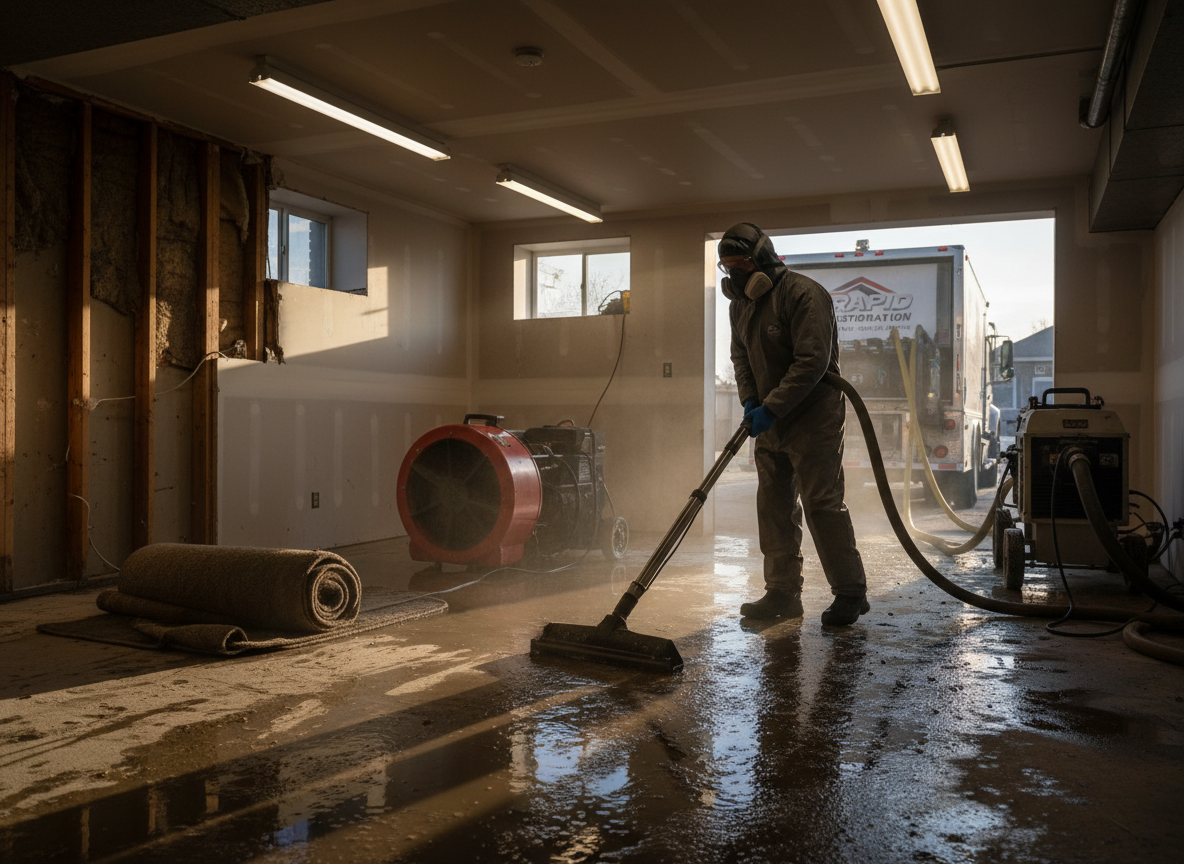
Holladay homes built before the 1980s in neighborhoods like Mount Olympus and Cottonwood often sit on clay-heavy soil that holds moisture long after snow melts. Winters bring repeated freeze-thaw cycles that push water through foundation cracks and into basements or crawl spaces. During mitigation we focus on hidden saturation behind plaster and under hardwood rather than surface drying alone, because the semi-arid summers that follow can trap that moisture and create hidden mold colonies.
Water extraction here requires different sequencing than in newer subdivisions. Many properties near Holladay City Park and Olympus Hills Park still have post-and-beam construction with limited access points, so we use targeted negative-pressure drying instead of whole-room fans. Salt Lake County code requires documentation of moisture levels before any wall or floor covering is replaced, which changes how we stage equipment and schedule follow-up visits compared with jobs in Millcreek or Cottonwood Heights.
Edge cases we see regularly involve irrigation leaks from older galvanized lines that travel under driveways and resurface inside finished lower levels. These jobs demand moisture mapping with infrared because visual signs appear days after the initial leak. We always pull baseboards and drill small inspection ports early so we can confirm the full extent before any reconstruction begins.
Technician insight
In Holladay, the thing that catches most people out with water damage mitigation is hidden moisture trapped in the dirt crawl spaces under 1960s homes near Mount Olympus, where winter snow melt sits against the foundation for weeks because the clay soil never fully drains.
Crawl-space saturation after spring runoff
Snow melt from higher elevations entered a crawl space in the Cottonwood neighborhood through a cracked foundation wall. We found standing water against the sill plate and elevated moisture in the subfloor above. Extraction and directed drying dried the space without disturbing finished floors. The homeowner avoided mold growth and larger repairs.
How it works
- 1
On-site evaluation
We map all affected materials and check moisture readings in walls, floors, and subflooring specific to the home's construction era.
- 2
Water extraction
Standing water is removed using pumps sized for the volume found in Holladay basements, followed by immediate containment to protect unaffected rooms.
- 3
Drying and dehumidification
Equipment is placed according to the home's layout, with daily monitoring to account for the area's low humidity swings between day and night.
- 4
Final verification
Moisture levels are rechecked against Salt Lake County standards before any surfaces are closed up or finishes reinstalled.
Pricing
Pricing depends on the volume of water, depth of saturation, and whether hidden cavities in older Holladay homes require additional access points.