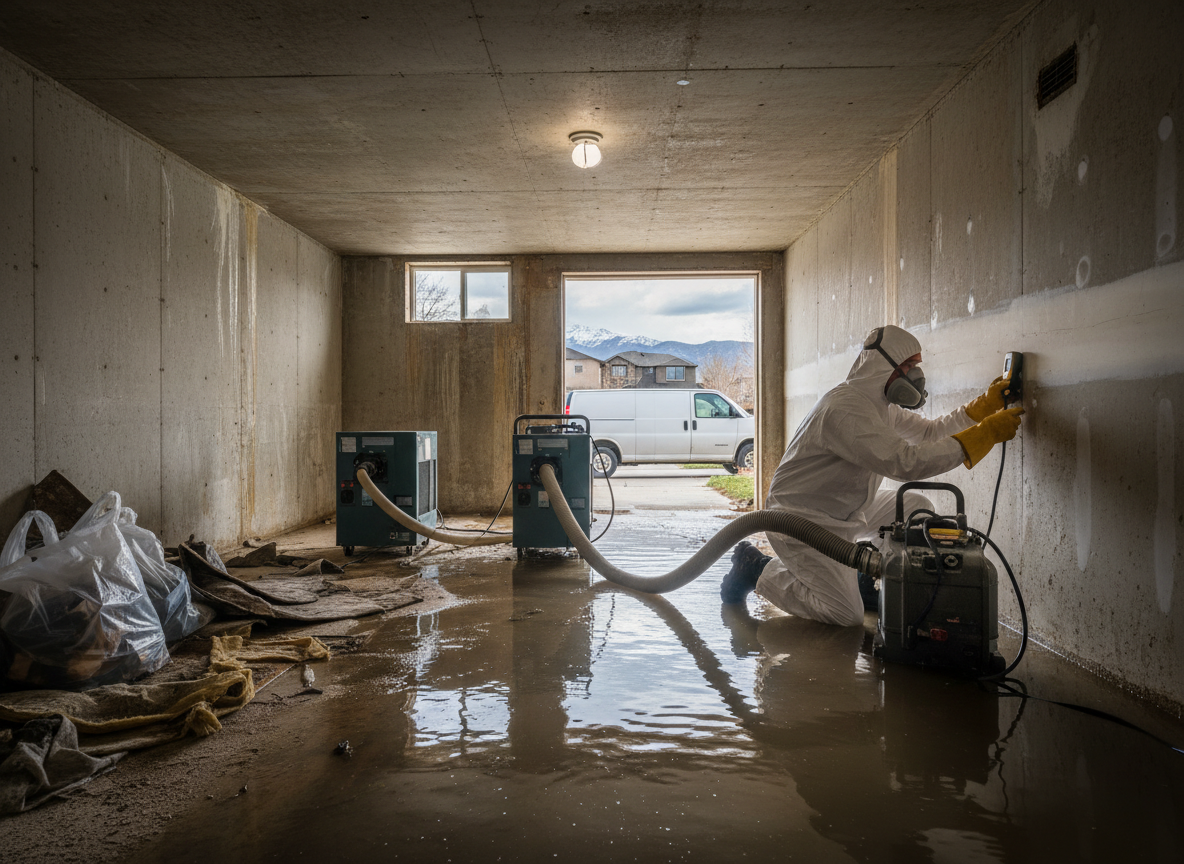
Holladay homes built before 1980 in neighborhoods like Mount Olympus and Cottonwood often have cast-iron or galvanized supply lines that corrode after decades of hard water exposure from the Wasatch Front aquifer. When a line fails during a January freeze, water can travel under slab foundations and into finished basements before residents notice. Technicians start with thermal imaging and pin meters to map hidden moisture behind plaster or lath walls rather than relying on surface readings alone.
Semi-arid summers bring sudden monsoon storms that overwhelm older clay-tile roof drains around Holladay City Park and Olympus Hills Park. Water backs up under eaves and saturates attic insulation in split-levels common to the area. Extraction crews use low-grain dehumidifiers sized for Salt Lake County’s low humidity to pull moisture from cellulose without over-drying oak floors or causing shrinkage cracks in trim. Containment barriers prevent cross-contamination between affected and unaffected levels.
Spring snowmelt from the benches above Millcreek and Cottonwood Heights frequently migrates through retaining walls into walk-out basements along Highland Drive. Crews install temporary French drains and negative-air machines to control humidity while removing saturated drywall up to the moisture line. Final clearance testing includes both relative humidity checks and calcium chloride tests on concrete slabs before any reconstruction begins.
Technician insight
In Holladay, the thing that catches most people out with water damage restoration near me is how snowmelt from the Olympus benches travels along the clay soil layer and pools against 1960s foundation walls in Mount Olympus, pushing moisture up through slab joints weeks after the visible leak stops.
Winter Pipe Burst in Holladay Village
A galvanized supply line split during a cold snap, flooding a finished basement in a 1972 split-level. Hidden moisture had wicked into the subfloor and lower wall cavities. Extraction and targeted drying prevented mold growth; only the affected baseboard and two sheets of drywall needed replacement before the space was returned to use.
How it works
- 1
Emergency Assessment
Technician arrives within hours, documents moisture with meters and imaging, and identifies safety hazards such as electrical exposure or structural compromise.
- 2
Water Extraction
Truck-mounted and portable pumps remove standing water from carpets, subfloors and wall cavities while protecting unaffected areas with plastic sheeting.
- 3
Drying and Monitoring
Industrial air movers and dehumidifiers run until moisture readings reach pre-loss levels; daily logs track progress and adjust equipment placement.
- 4
Sanitizing and Restoration
Antimicrobial treatment follows drying; damaged materials are replaced and finishes matched to original construction in Holladay homes.
Pricing
Upfront quotes after inspection reflect scope, materials affected, and access challenges common in Holladay’s older housing stock.