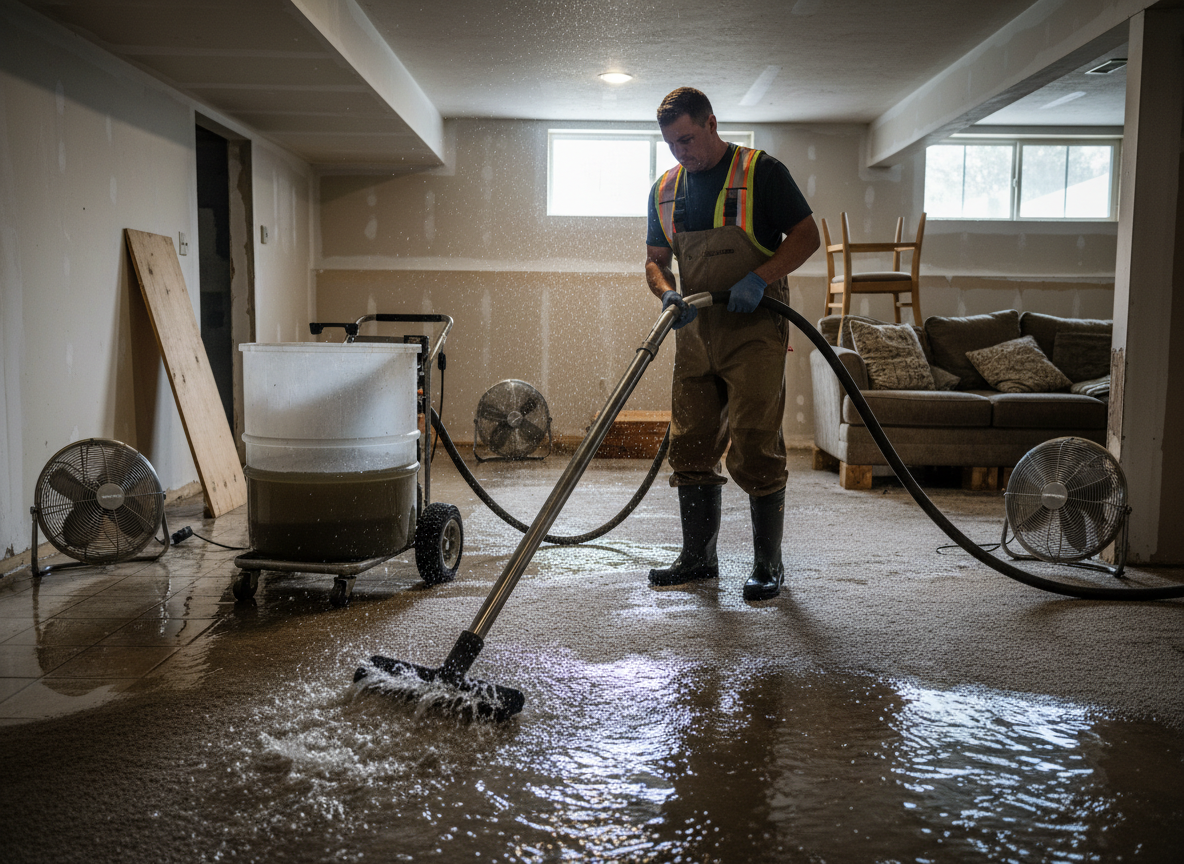
Holladay's semi-arid climate brings cold snowy winters that frequently freeze pipes in homes built before 1980 around Holladay Village and near Olympus Hills Park. Rapid water extraction begins with locating the source, often in basements or crawl spaces common to Mount Olympus properties, then deploys truck-mounted pumps to remove standing water before it migrates into Salt Lake County's clay-heavy soils. Delaying even a few hours allows moisture to wick into hardwood floors and drywall, especially in the compact lots typical of Cottonwood neighborhoods.
Technicians must account for the terrain sloping toward Millcreek and Cottonwood Heights, where water can pool against foundations after heavy spring melt. Industrial vacuums and moisture meters map saturation levels room by room, preventing hidden pockets that later cause structural issues in older Salt Lake County construction. Hot summer afternoons add another layer when sudden thunderstorms overwhelm older drainage around Holladay City Park, requiring extraction that also addresses humidity trapped inside stucco exteriors.
Extraction crews work from the 6245 Highland Dr base to reach nearby Millcreek and Salt Lake City jobs within the hour, using equipment sized for the volume typical of these single-family homes. The process includes documenting every step for insurance adjusters who know Holladay's mix of mid-century and newer builds. Proper sequencing avoids pushing water deeper into wall cavities, a common error when crews overlook the layered insulation found in many local properties.
Technician insight
In Holladay, the thing that catches most people out with Rapid water extraction is how older homes near Mount Olympus have shallow crawl spaces that fill during winter thaws; if you don't pull every gallon before it soaks the clay soil against the foundation, it travels under the slab and shows up weeks later in the laundry room.
Frozen Pipe Flood in Holladay Village
A homeowner near Holladay City Park discovered water spreading across the basement after a January freeze. Extraction crews found standing water against the foundation wall and used pumps to clear it before it reached the electrical panel. Targeted drying prevented damage to nearby drywall and flooring.
How it works
- 1
Initial Assessment
Technicians arrive on site, identify the water source, and map affected zones in the home's basement or crawl space.
- 2
Standing Water Removal
Truck-mounted pumps extract bulk water while containing runoff on sloped lots common in Cottonwood.
- 3
Moisture Mapping
Infrared meters locate hidden saturation in walls and floors of older Holladay Village homes.
- 4
Drying Setup
Air movers and dehumidifiers are positioned to address residual moisture from snowy winter events.
- 5
Final Verification
Readings confirm dryness levels before equipment removal and site handoff.
Pricing
Pricing varies with water volume, square footage affected, and whether extraction occurs in finished basements or crawl spaces.