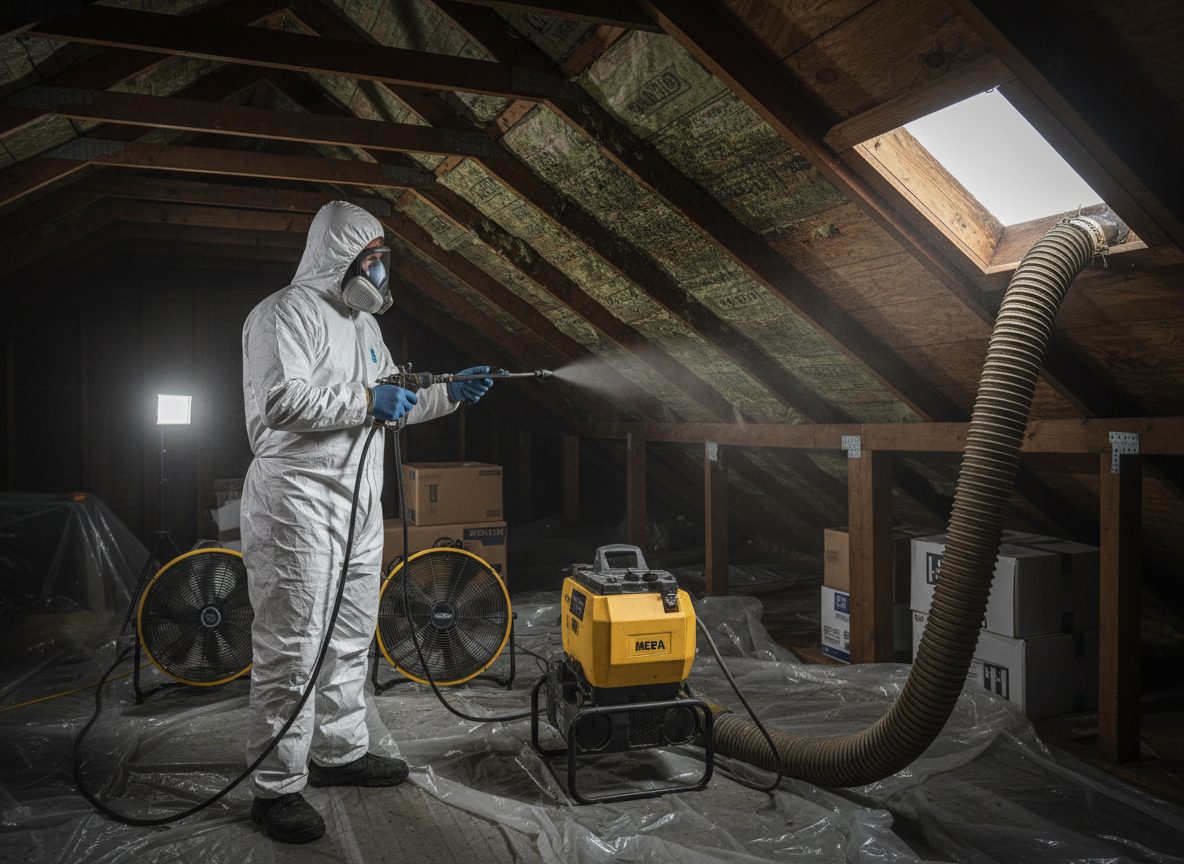
Holladay homes in neighborhoods like Cottonwood and Mount Olympus often feature older rooflines and limited ridge venting that trap moisture after heavy winter snow. When meltwater finds its way past aging flashing or ice dams, it soaks insulation and sheathing, allowing mold to establish in the attic before homeowners notice ceiling stains below. Proper remediation requires isolating the affected bays, removing saturated materials, and drying to below 12 percent moisture content before any new insulation goes in.
Semi-arid summers in Salt Lake County dry surface moisture quickly, yet attics stay humid because poor soffit intake lets warm air stagnate. Technicians must check every rafter bay with a moisture meter rather than relying on visible growth alone. In homes near Olympus Hills Park, cathedral ceilings and spray-foam retrofits can hide active colonies, so containment barriers and negative air machines are set before disturbing any material.
Edge cases include mold that has crossed into wall cavities when roof leaks travel down rafters into top plates. Removing only attic insulation without addressing the wall tops leaves spores ready to regrow once humidity rises again. Local building practices from the 1970s and 1980s mean many Holladay attics still contain kraft-faced batts that trap vapor, requiring full removal rather than surface cleaning.
Code notes for Salt Lake County require permits when more than 10 percent of the attic structure is disturbed, and disposal of contaminated insulation must follow county landfill rules. Homeowners should expect the crew to document moisture readings at multiple depths and provide a written drying plan before any reconstruction begins.
Technician insight
In Holladay, the thing that catches most people out with attic mold remediation is the way heavy winter snow on older roofs in Mount Olympus and Cottonwood creates ice dams that push water under shingles weeks after the storm; by spring the mold is already growing behind the insulation where standard visual checks miss it.
Hidden Leak Above Holladay Village
A homeowner near Holladay City Park noticed brown ceiling spots after March snowmelt. Inspection found water had traveled along rafters from a blocked gutter, soaking cellulose insulation across six bays. The crew contained the space, removed the wet material, dried the sheathing to 10 percent, and treated the framing. New insulation and added ridge vents were installed once clearance readings passed.
How it works
- 1
Inspection and Moisture Mapping
Technicians access the attic from Holladay homes and map moisture levels across rafters, sheathing, and insulation using pin and pinless meters.
- 2
Containment and Negative Air Setup
Plastic barriers and HEPA air scrubbers isolate the work zone to prevent spores from migrating into living spaces below.
- 3
Removal of Affected Materials
Saturated insulation, drywall, and wood are cut out and bagged for disposal while keeping the rest of the attic intact.
- 4
Drying and Antimicrobial Treatment
Air movers and dehumidifiers bring wood moisture content below 12 percent; EPA-registered antimicrobials are applied to remaining framing.
- 5
Final Clearance and Rebuild Planning
Post-remediation readings and visual inspection confirm the space is dry; recommendations for improved ventilation are provided before insulation replacement.
Pricing
Cost depends on attic size, depth of insulation removal, and whether wall cavities are involved; written estimates are provided after the initial inspection.